O'Maro Bekele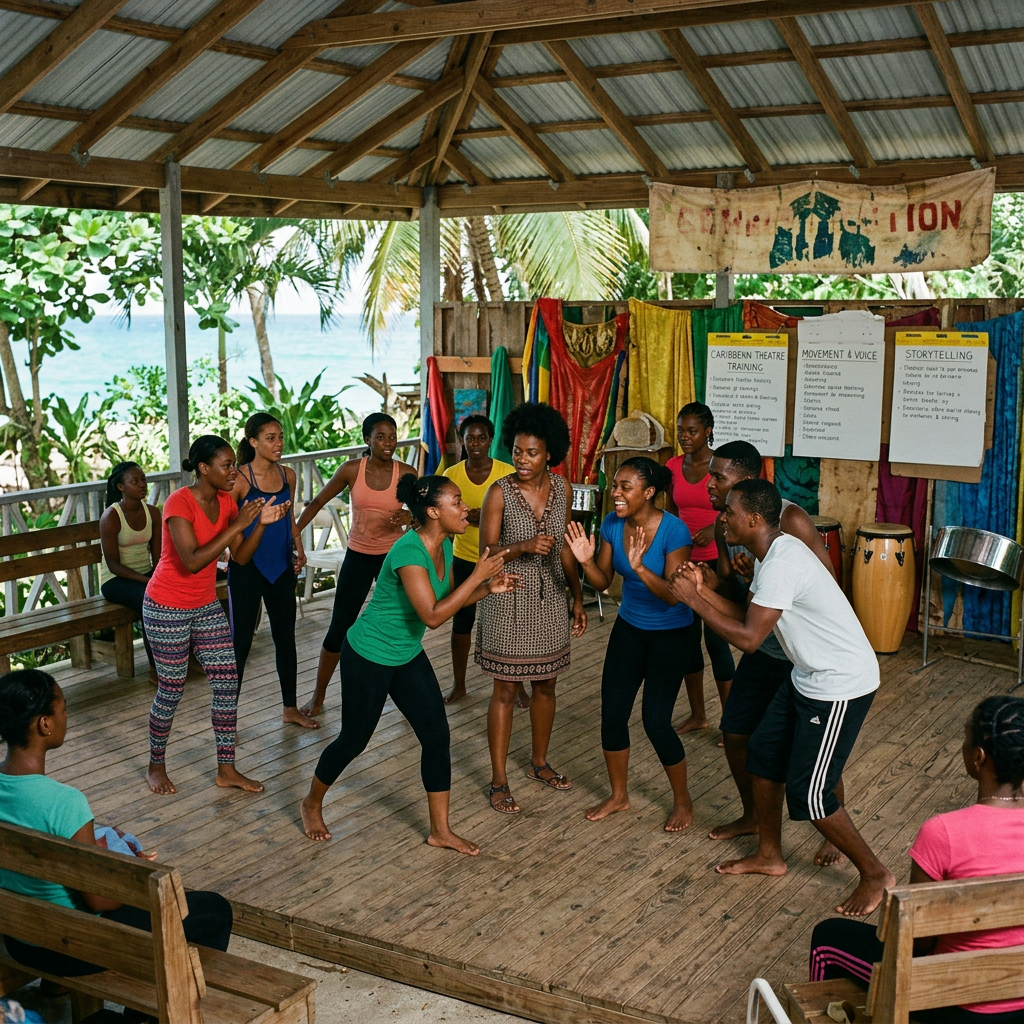
8 minutes read time.
Are Caribbean theatre schools preparing students for the creative economy or only the stage?
The World University of Design in India recently announced new four year undergraduate and two year postgraduate theatre programmes for the 2026–27 academic year, explicitly framing formal performance training as creative industry career preparation. Unlike conventional theatre courses, these programmes go beyond performance skills to train well rounded theatre professionals, incorporating direction, stagecraft, contemporary storytelling techniques and entrepreneurial thinking. Graduates are prepared not only to perform but also to create, lead and innovate across cinema, OTT platforms, immersive experiences, live entertainment, cultural tourism, museums, education and digital storytelling.
The question now facing the Caribbean is this: Are our theatre schools keeping pace?
For decades, theatre training in the Caribbean has centred on the proscenium stage. The Edna Manley College of the Visual and Performing Arts, the region’s premier arts institution, offers Bachelor of Fine Arts in Theatre Arts – Acting, Associate of Arts in Theatre Arts, and Postgraduate Diploma in Arts Education. The University of the West Indies, Mona, in association with Edna Manley, offers a BA in Drama designed to train the native theatrical talents of Caribbean people. The University of the West Indies, St Augustine offers a BA in Theatre Arts alongside certificate programmes in Technical Theatre and Drama in Education. Excelsior Community College in Jamaica offers an Associate of Arts Degree in Performing Arts, a Technical Certificate in the Performing Arts with specialisations in Dance, Drama or Music, and a four year Bachelor of Fine Arts in Performing Arts, an integrated programme covering music, dance and drama. The University of Trinidad and Tobago’s Academy for the Performing Arts offers a four year Bachelor of Fine Arts in Performing Arts. Barbados Community College offers a two year Associate Degree in Theatre Arts.
These are essential foundations. But are they enough?
The creative economy is no longer a peripheral conversation. Globally, creative industries generate more than US$2 trillion in revenue annually and support nearly 50 million jobs worldwide. Jamaica’s own government has recognised this reality. Minister of Education, Skills, Youth and Information, Senator Dana Morris Dixon, recently announced a creative education pathway designed to formalise Jamaica’s creative education system and develop a skilled cultural workforce. “We are building a pipeline of creative professionals and institutions that nurture talent from the earliest years, refine it through specialised education, propel it into professional practice, and link it to markets, both locally and globally,” she said.
The pathway includes three performing arts secondary schools, one in each county, integrating academic and artistic disciplines in music, dance, theatre, visual arts and media. A Cultural Apprenticeship Programme will offer 200 individuals mentorship and hands on training in stagecraft, film and cultural management.
This is significant. The government is signalling that performing arts education is not a cultural luxury but an economic necessity.
The Jamaica Musical Theatre Company has taken a similar approach with its Theatrix Apprenticeship Programme, launched in response to the limited availability of structured training in dance, theatre management, stage production, technical theatre and arts education. Danielle Stiebel Johnson, chairman and producer of JMTC, explained the vision: “We kept seeing a gap in the industry. Many young creatives are passionate about theatre, but they often only see the performer’s side of it. We wanted to pull back the curtain and show them that theatre is also built by stage managers, technicians, makeup artists, designers, producers, writers, educators and administrators”.

Unlike traditional theatre training programmes, TAP places significant emphasis on the disciplines that operate behind the scenes. Participants are immersed in real production scenarios where they learn through hands on practice rather than passive instruction. The programme covers technical literacy, strategic planning, live cue practice, character transformation, hygiene, safety, kit management and backstage workflow.
“Theatre does not happen because of performers alone,” Stiebel Johnson said. “A brilliant performance still needs someone to call the cues, manage rehearsals, design the look, coordinate the crew, teach the craft, build the production schedule and ensure the creative vision can function onstage”.
This is precisely the reframing that the World University of Design has championed. Performance is no longer confined to the stage. It has become central to cinema, digital storytelling, live experiences, education and the broader creative economy.
So where do Caribbean theatre schools stand?
Some institutions are already moving in this direction. Edna Manley College houses five schools: Visual Arts, Drama, Dance, Music and Arts Management & Humanities. The School of Arts Management offers a BA Arts Management programme that aims to build a reserve of trained arts managers and administrators with the vision, foresight and creativity to move the arts forward in Jamaica and the Caribbean. The college also offers a BA in Drama in Education, preparing teachers who can contribute to the development and execution of educational drama programmes.
The University of the West Indies, St Augustine offers a Postgraduate Diploma in Arts and Cultural Enterprise Management and an MA in Creative Design Entrepreneurship. The UWI, Cave Hill offers an MA in Creative Arts with specialisations including Arts Entrepreneur. Courses examine the theoretical aspects of creative and cultural industries within the social, cultural, economic, political and Caribbean context.
Barbados Community College’s Associate Degree in Theatre Arts seeks to provide students with sound knowledge of Caribbean and classical theatre forms, preparing cultural professionals to perform competitively on the national, regional and global cultural stage.
The Bahamas Creative and Performing Arts School, which opened in September 2025, is positioned as a tertiary level institution offering professional training to international industry standard. The school is built on the principle that there is significant economic potential to be derived from the commercialisation of talent.
These are encouraging developments. But gaps remain.
Intellectual property training, for instance, is critical for creative economy careers yet remains underdeveloped in many theatre programmes. Jamaica is working with the World Intellectual Property Organization to strengthen IP protection and is moving toward establishing a national IP training institute. The UWI offers a course introducing students to concepts of intellectual property and its management with a particular focus on cultural and creative industries. But these offerings are not yet standard in theatre curricula across the region.
Digital media training is another area requiring attention. While some programmes incorporate new media and performance practice, the integration of digital tools into theatre education remains uneven. The TUI Colourful Cultures Jamaica programme offers performing arts and digital media creatives training opportunities to grow entrepreneurial spirit and business skills. A new training institute for Jamaica’s entertainment and creative industries is also being established, with courses projected to include music production, audio engineering, sound design and music business. Theatre schools must ensure their students are not left behind.
Entrepreneurship education is gaining ground but is not yet universal. The Caribbean Examinations Council’s Theatre Arts syllabus includes units on Business for the Arts, focusing on product development and management. The Business of the Arts Programme in St Lucia is designed to develop entrepreneurial skills and knowledge, exposing participants to methods for formulating innovative ideas and identifying opportunities to materialise successful creative products and businesses. These are steps in the right direction.
The Green Paper on the National Policy for Culture, Entertainment and the Creative Economy, tabled in Jamaica’s House of Representatives in October 2025, provides a blueprint for growth through innovative strategies focusing on cultural diversity, equity and inclusion. It leverages frontier technologies such as artificial intelligence and digital tools to empower creatives. This policy framework creates space for theatre education to evolve.
But policy alone is not enough. Theatre schools must ask themselves hard questions. Are we producing graduates who can only act, or are we producing graduates who can produce, manage, market, protect their intellectual property, leverage digital platforms and build sustainable careers? Are we training artists for the stage or cultural entrepreneurs for the creative economy?
The answer, increasingly, is both.
The Caribbean is rich with cultural capital. Jamaican music, dance, theatre and storytelling have global reach. The region’s festivals, carnivals and cultural expressions are economic drivers. The challenge is to ensure that theatre training equips students not only with performance skills but with the business acumen, technical knowledge and entrepreneurial mindset to monetise their talent.
Stiebel Johnson put it succinctly: “Passion is the starting point, but training helps turn that passion into skill, discipline, reliability and employability. Talent matters, but so do professionalism, communication, documentation, safety, time management and the ability to work within a team”. Certification gives creatives something tangible to show employers, collaborators and investors.
The World University of Design has recognised that the performing arts professional must be both an expert in their specialisation and a thorough generalist in performance management, production, promotion and presentation. Caribbean theatre schools are beginning to embrace this vision. The question is whether they will move fast enough.
The creative economy is not waiting. Neither should our theatre schools.